

 Español
 عربى
Content
- 1 What Counts as BBQ Grill Accessories
- 2 The Core Kit: Four Tools That Earn Permanent Space
- 3 Material and Thickness Decide the Second Season
- 4 Fit: Measure the Opening, Not the Old Grate
- 5 Staging and Storage Between Cooks
- 6 Buying for a Brand: What to Confirm With a Manufacturer
- 7 Frequently Asked Questions
Short answer: buy the four tools that touch food or sit in the heat first - tongs, a rigid spatula, a bristle-safe grate brush and a calibrated thermometer - then add a grill mesh panel, a folding side table and a basket to keep the set together. Everything else is optional.
Accessories are the cheapest part of a barbecue setup and the most common source of returns. A 0.6 mm chrome-plated topper that looks fine on a shelf will bow the first time it sits over a full chimney of charcoal. A mesh panel cut 10 mm too wide will never sit flat, and a brush with loose bristles is a safety problem rather than a quality annoyance. The checks below predict whether a set survives a second summer, whether you are buying one set for a balcony or a container load for a retail programme.
What Counts as BBQ Grill Accessories
A BBQ grill accessory is any removable item - metal, ceramic or heat-resistant composite - that sits on, in, under or beside the cooker and is not part of its fixed body. Because accessories are almost always sold separately from the grill, compatibility is the buyer's responsibility rather than the cooker manufacturer's.
- Contact tools: tongs, spatulas, forks, basting brushes, heat-resistant gloves.
- Surface modifiers: grill mesh panels, toppers, skewer racks, vegetable baskets, pizza plates.
- Heat and airflow gear: chimney starters, charcoal baskets, ash rakes, heat deflectors.
- Reading instruments: probe thermometers, infrared thermometers, lid gauges.
- Staging and storage: folding side tables, trays, mesh baskets, covers.
Catalogues are easiest to sort by how often an item is used rather than by price. Contact tools are used every cook, surface modifiers several times a week, staging items once per session. That order is also a sensible buying order, and it matches how most outdoor grilling accessories ranges are merchandised.
The Core Kit: Four Tools That Earn Permanent Space
If a set includes only four items, they should be tongs, a spatula, a grate brush and a thermometer. Each has one failure mode that matters far more than price, and each failure is predictable from the specification sheet.
| Tool | Check before buying | Typical failure |
|---|---|---|
| Tongs | Spring tension, scalloped tip, 30 to 40 cm length, 1.0 mm or thicker stainless | Tips splay after a few months and lose grip on a 2 kg roast |
| Spatula | Blade 1.5 mm or thicker, offset neck, 12 cm blade width | Blade bends under a burger press; handle joint works loose |
| Grate brush | Coiled stainless head or replaceable cartridge, no free bristles | Bristles shed into food, which is a genuine safety issue |
| Thermometer | Accuracy of ±1 °C, calibration nut, 2 to 3 second read | Drifts 5 to 8 °C after one season without recalibration |
Everything beyond these four is a cooking preference. A second pair of tongs or a burger press improves a specific cook; none of them rescues a set built on thin steel.
Surface modifiers change what the grill can cook
A grill mesh panel is the highest-value add-on after the core four, because it turns wide grate bars into a usable flat surface for fish, sliced vegetables, small skewers and anything narrower than the gap between bars.
Mesh aperture is the specification that decides usefulness. A 6 x 6 mm aperture suits fish and loose vegetables, 10 x 10 mm is a general-purpose choice, and anything above 12 x 12 mm behaves like a grate again. Keep open area at 55 percent or more so airflow and flare-up behaviour stay close to the bare grill.
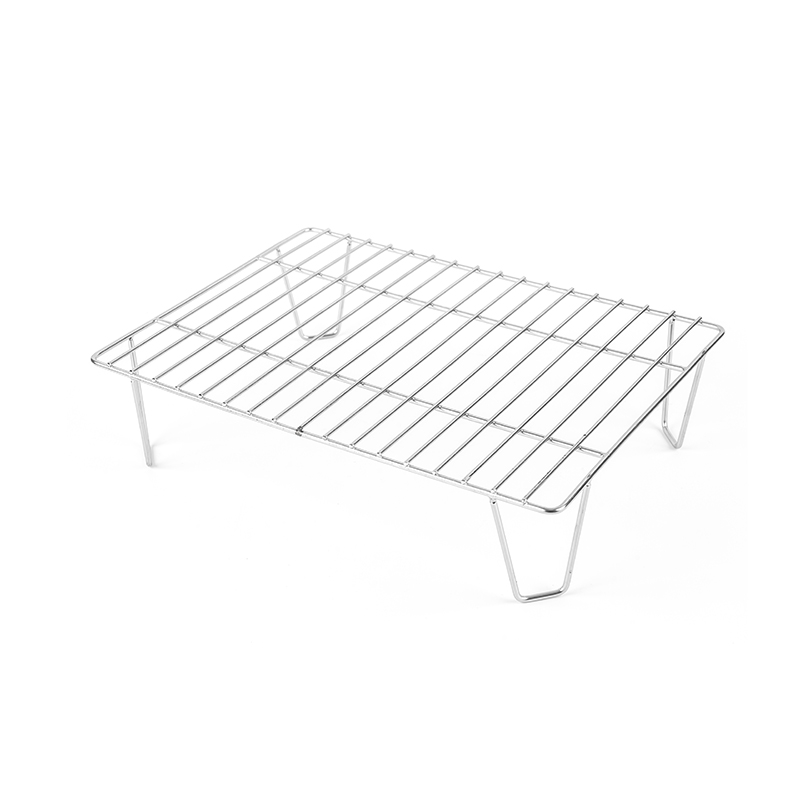 CZO 20 304 Stainless Steel Cooling RackCheck the CZO 20's 304 stainless steel grade and open wire grid for airflow; smooth no-snag edges suit jelly roll pans and cooling.View Product →
Material and Thickness Decide the Second Season
Grade and gauge, not catalogue language, decide whether an accessory survives to a second summer. Plating is a finish, not a material, and it fails at a temperature the base steel would happily tolerate.
| Material | Typical thickness | Heat behaviour | Care | Sensible use |
|---|---|---|---|---|
| 304 stainless | 0.8 to 1.5 mm | Stable to roughly 800 °C, no coating to fail | Dishwasher safe | Tongs, mesh panels, racks, skewers |
| 430 stainless | 0.6 to 1.0 mm | Fine for indirect heat, discolours with direct flame | Hand dry promptly | Budget trays and drip pans |
| Carbon steel | 1.5 to 3 mm | Holds heat well, warps if left unseasoned and wet | Oil after every use | Grates, plancha plates, skewers |
| Chrome-plated steel | 0.5 to 0.8 mm | Plating breaks down above about 400 °C and flakes at scratches | No abrasives | Low-cost toppers and baskets |
| Cast iron | 3 to 6 mm | Very high heat retention, slow to heat up | Season, never soak | Searing presses and serving plates |
Two numbers are worth writing into any specification. The first is thickness tolerance: ±0.05 mm is normal for cold-rolled stainless sheet, and a supplier who cannot state it is guessing. The second is salt spray hours. For 304 stainless, 48 hours is a reasonable baseline for inland markets, while coastal markets usually need 96 to 200 hours, or an electro-polished surface, to avoid staining at weld seams.
Fit: Measure the Opening, Not the Old Grate
Fit failures almost always come from measuring the wrong object. Measure the clear opening of the firebox, not the grate you are replacing, because the old part may already be out of tolerance.
- Measure width and depth at three points each; fireboxes are rarely perfectly square.
- Subtract 5 mm of total clearance for thermal expansion, so a 600 mm opening takes a 595 mm panel.
- Check lid clearance: a topper plus food adds 30 to 60 mm of height.
- Confirm how the part is supported - a ledge, cross bars, or a 12 mm lip for mesh frames.
- On gas grills, leave at least 40 percent of the burner area unobstructed.
Fabricated mesh normally carries a ±3 mm tolerance and laser-cut frames ±2 mm. Ask for the drawing tolerance rather than assuming the nominal size, especially on repeat orders where a new batch of sheet can shift a fold by a millimetre or two.
Staging and Storage Between Cooks
Most accessory sets degrade in storage rather than on the grill. Moisture, scratches and misplaced parts do more damage over a season than heat ever does.
A folding side table is the most useful staging item: 60 x 40 cm of level surface beside the grill keeps raw and cooked food apart and gives somewhere to rest a tray. Check the load rating (15 to 25 kg is typical for a steel frame), that the legs lock open, and that the powder coating is specified at 60 to 80 microns so it does not chip at the hinges.
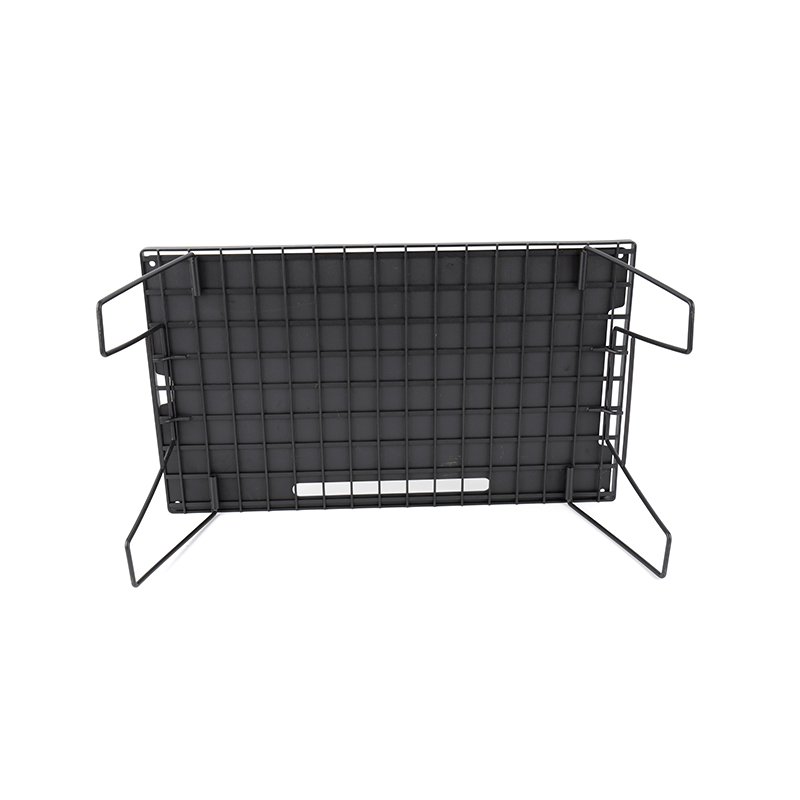 CZO 13 Folding Plastic Table for Indoor and Outdoor UseCompact black folding table with a stable surface and easy storage; its 60.7 x 35.6 x 24 cm size suits event or outdoor staging.View Product →
A mesh basket with airflow keeps tools dry between cooks and stops the brush sitting in its own residue. Store damp tools loose rather than sealed, and never put a carbon steel or cast iron accessory away wet.
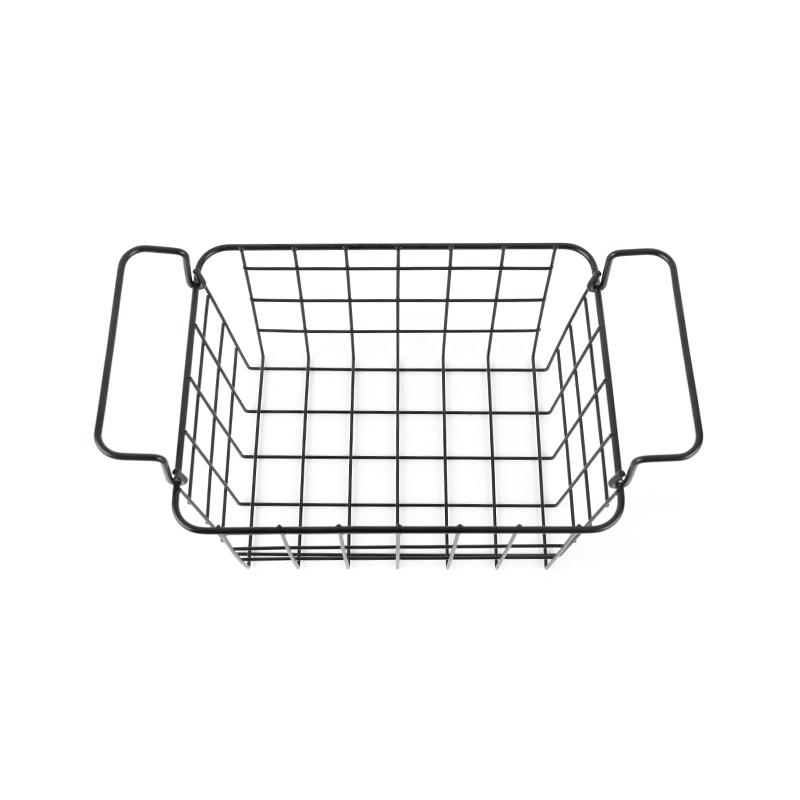 CZO 12 Large Stackable Wire Mesh Storage BinFor resale buyers, check the 25 x 19 x 12.5 cm wire mesh bin's stackable form for pantry, office, or closet organization.View Product →
Buying for a Brand: What to Confirm With a Manufacturer
When accessories are bought for resale, the specification sheet matters more than the sample. Samples are hand-finished; production is not.
- Material paperwork: grade certificate, thickness tolerance, weld penetration on frame joints.
- Flatness: 2 mm or less of deviation per 500 mm, measured on a surface plate rather than by eye.
- Finish: coating thickness in microns, edge radius under 0.5 mm, no spatter on food-contact surfaces.
- Corrosion testing: salt spray hours tied to the destination market, not to a generic claim.
- Packaging: drop test, rust-preventive paper, carton artwork approved before mass production.
Ask for the inspection report, not just the certificate. A manufacturer working to strict quality control should be able to show incoming material checks, in-process dimensional checks and a final flatness measurement on the same document.
Frequently Asked Questions
Do I need a full accessory set to start grilling?
No. Tongs, a spatula, a brush and a thermometer cover nearly every cook. Add a mesh panel if you cook fish or vegetables, and a side table if you lack prep space.
Is a grill mesh panel worth buying?
Yes, if the aperture matches your cooking. Buy 6 x 6 mm for delicate food and 10 x 10 mm for general use, confirm the frame has a 12 mm lip, and check that open area stays above 55 percent so airflow is not restricted.
What thickness should stainless tongs be?
Between 1.0 and 1.2 mm for 304 stainless. Thinner steel springs back after a few months of gripping heavy roasts, while thicker stock becomes tiring to squeeze through a long cook.
How do I keep accessories from rusting?
Dry them fully, store them loose in a ventilated basket and keep carbon steel oiled. Surface rust on 304 usually comes from trapped moisture or contact with a dissimilar metal, not from the grade itself.
Can accessories be customised for a private label?
Yes. Colour, coating, handle shape, laser-cut logos, packaging and dimensional variants are all feasible on metal accessories; the practical questions are tooling cost, sample lead time and minimum order quantity rather than capability.
The short version of all of this: buy for heat, fit and finish, in that order, and the rest of the catalogue can wait.